
Wausau · Marathon County · Wisconsin
Spray Foam Insulation Contractor in Wausau, WI
Attics, walls, rim joists, crawl spaces, pole barns and flat roofs, insulated for a town that averages 8,174 heating degree days a year. We seal the leaks first, then add the right material to the depth Wisconsin's code calls for.
- Marathon County: code Zone 1, R-49 ceilings
- January average low 6.7°F
- Closed-cell, open-cell, blown-in
Spray Foam Insulation Near Me: Where a Wausau House Actually Loses Heat
Most heat doesn't leave through the middle of a wall. It leaves at the joints: the top plates and light fixtures under the attic, the rim joist sitting on the foundation, the crawl space under an addition. Tap a part of the house to see what we do there and why.
-
Attic insulation and air sealing
Seal the top plates, chases, bath fans and light boxes, then bring the attic floor to R-49, the ceiling minimum in Marathon County. Warm air leaking into the attic is the main driver of ice dams.
-
Wall insulation
Open studs in a remodel, addition or garage get spray foam or batts. Closed, finished walls in older houses can be dense-packed from outside or inside without tearing them open.
-
Rim joist and sill plate
The framing that sits on the foundation is thin wood with gaps on both sides. Closed-cell foam seals and insulates it in one pass, and Wisconsin's code lets foam stay uncovered there.
-
Basement walls
Code calls for R-15 continuous or R-19 in a framed cavity on basement walls. Closed-cell foam against the concrete keeps damp air from reaching a cold surface behind the drywall.
-
Crawl space
Cover the dirt, seal the vents and rim, and foam the walls so the floor above and the pipes in the crawl stay warm. That beats chasing fallen batts under the floor.
Spray Foam Insulation Company for Houses, Shops and Flat Roofs
Nine kinds of work, each with its own page explaining the materials, the code numbers and the decisions you'll face. Spray foam is one tool; for some of these jobs it isn't the one we'd pick.
-

Attic insulation and air sealing
Seal the ceiling plane, then bring the attic floor up to code depth. The fix for ice dams and cold upstairs rooms.
-

Wall insulation
Open studs in a remodel or addition, garage walls, and the cavities in older Wausau houses that were built with nothing in them.
-

Basement and rim joist insulation
The band of framing on top of the foundation is the leakiest spot in most basements. Closed-cell foam seals and insulates it in one pass.
-

Crawl space insulation
Ground cover, sealed vents and foam on the walls so the floor above stays warm and the pipes stay thawed.
-

Closed-cell and open-cell spray foam
Two different materials with different jobs. Where each one belongs in a Marathon County house or shop.
-

Blown-in insulation
Loose-fill cellulose, fiberglass or mineral wool for open attic floors and dense-packed wall cavities.
-

Insulation removal
Vacuum out wet, mouse-fouled or smoke-damaged fill, or cut back foam that was sprayed wrong, before anything new goes in.
-

Spray foam roofing
Closed-cell foam plus a protective coating over flat and low-slope commercial roofs: insulation and the waterproof layer in one system.
-
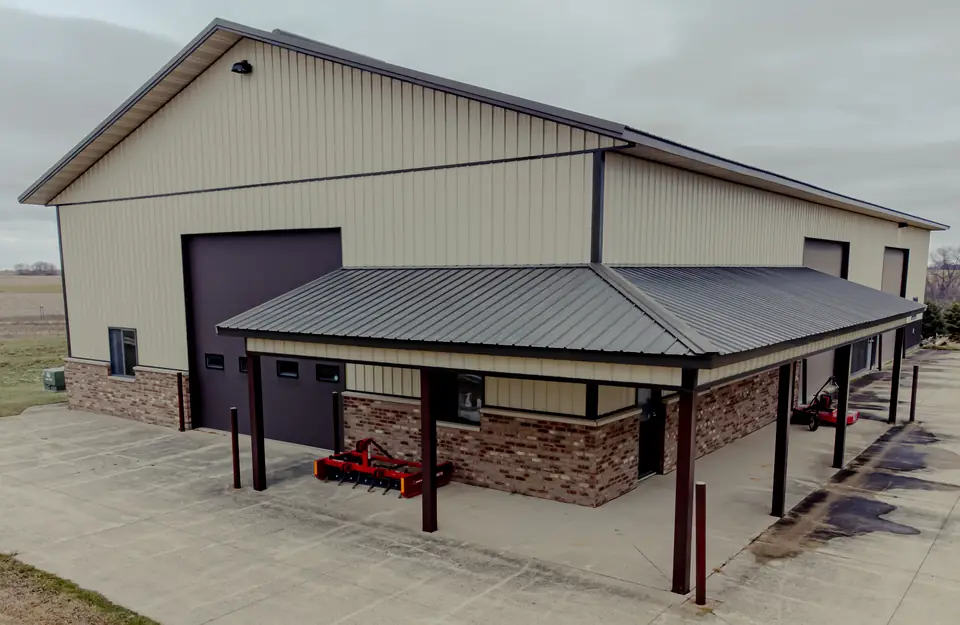
Pole barn and metal building insulation
Stop the dripping under steel roofs and make a shop, machine shed or barndominium heatable through a Wausau winter.
Spray Foam Insulation Types and the Other Materials We Install
Five materials cover nearly every job on this site. Each has a spot where it beats the others and a spot where it's the wrong call. Swipe or use the arrows.
-
Closed-cell spray foam
- R per inch
- about 6.1 (aged)
- Vapor
- under 1 perm at 2 in.
- Density
- about 2 lb per cu ft
For anything cold or damp: rim joists, concrete, pole barn steel, roof decks. Hard, rigid and sprayed in passes. It costs the most per inch, so it goes where nothing cheaper does the job. Closed vs open cell, spot by spot.
-
Open-cell spray foam
- R per inch
- about 3.6
- Vapor
- vapor-open, about 10 perms at 5 in.
- Density
- about 0.5 lb per cu ft
Fills a deep cavity completely for less money and stops air, but lets vapor through, so in an outside wall it needs a vapor retarder in front. Never below grade or on steel. Good in 2x6 walls behind a vapor retarder and for sound.
-
Blown cellulose
- R per inch
- 3.2 to 3.8, settled
- R-49 depth
- about 13 to 15 in.
- Made from
- recycled paper, fire-treated
The usual answer for an open attic floor once the leaks are sealed, and dense-packed through small holes, for the closed walls of older houses. Loose fill and dense-pack compared.
-
Fiberglass, batts and loose fill
- R per inch
- 2.2 to 2.7 loose, settled
- Water
- doesn't absorb it
- Air
- passes straight through
Cheap and fine where air can't reach it. Batts in open studs work when they're cut around every box; loose fill tops up an attic. Fiberglass alone in a rim joist or over a leaky ceiling is the classic mistake. See attic sealing and depth.
-
Roofing foam and coating
- What it is
- closed-cell foam on top of the roof
- Covered by
- a UV coating or aggregate
- Upkeep
- inspections and recoats
On a flat or low-slope roof the foam is the insulation and the waterproofing in one seamless layer, sloped toward the drains. The coating keeps sunlight off it. When a foam roof makes sense.
R per inch, density and perm: DOE Building America spray foam guide; loose-fill ranges: PNNL Building America Solution Center; coatings: IBHS. Stock photos, not our jobs.
Cold Rooms, Frozen Pipes, Dripping Shop Roofs: What Insulation Fixes Each Problem
People rarely call asking for "insulation." They call about a symptom. These are the ones we hear about most around Wausau, with the usual cause and where the fix starts.
| What you notice | Usual cause | Where the fix starts |
|---|---|---|
| Ice ridge and icicles at the eaves, water stains on upstairs ceilings | House air leaking into the attic warms the roof deck; snowmelt refreezes at the cold overhang | Seal the attic floor, then insulate |
| Cold draft at the base of first-floor walls, frost on basement band joists | Air leaking through the rim joist and sill plate | Closed-cell foam on the rim |
| Bedroom over the garage that never warms up | Garage ceiling with gaps or thin batts | Foam or dense fill in the garage ceiling |
| Cold floors and frozen pipes in an addition or 3-season room | Vented crawl space with sagging or missing insulation | Seal and insulate the crawl space walls |
| Water dripping from roof steel in a shop or machine shed | Warm, moist air hitting steel colder than its dew point | Closed-cell foam on the steel |
| Exterior walls cold to the touch in an older house | Empty or slumped wall cavities | Dense-pack or foam the walls |
| Musty or mouse-fouled attic insulation | Old fill past saving | Vacuum it out before anything new goes in |
| Flat commercial roof that leaks and holds water | Failed membrane over wet or thin insulation | Foam roof system (if the deck is sound) |
What Wisconsin's Energy Code Requires for Insulation in Marathon County
One- and two-family homes in Wisconsin are built to the Uniform Dwelling Code. Its energy chapter (SPS 322) splits the state into two zones. Marathon County is Zone 1 (climate zone 6 on the national map). Drive north into Lincoln County toward Merrill and you're in Zone 2, where framed walls need R-21 and floors R-38.
These are minimums for new work. When we insulate an existing house we use them as the target, not a ceiling. Pick a part of the house:
| Part of the house | Zone 1 (Marathon County) | Zone 2 (Lincoln, Langlade, Taylor) |
|---|---|---|
| Ceiling | R-49 | R-49 |
| Wood-frame wall | R-20, or R-13 cavity + R-5 sheathing | R-21 |
| Basement wall | R-15 continuous or R-19 cavity | R-15 continuous or R-19 cavity |
| Crawl space wall | R-10 continuous or R-13 cavity | R-10 continuous or R-13 cavity |
| Floor | R-30 (or fill the joist cavity to R-19) | R-38 |
| Windows (U-factor, maximum) | 0.35 | 0.35 |
R-49 is roughly 13 to 15 inches of settled cellulose. Most Wausau attics we look into have far less, often old fiberglass that has packed down. Where there's no attic floor to fill, foam on the underside of the roof deck does the job. More on attic insulation.
R-20 won't fit in a 2x4 wall with fluffy insulation. That's why older houses get dense-pack or foam, and why new 2x6 walls are the norm here. More on wall insulation.
Two numbers, two methods. R-15 if the insulation is a continuous layer against the concrete, R-19 if it sits between studs. Closed-cell foam counts as the continuous layer. More on basement and rim joist insulation.
Insulate the walls, not just the floor. The code gives a crawl space wall option, which keeps pipes in the crawl inside the warm side. More on crawl space insulation.
Floors over garages and vented crawl spaces. R-30, or a joist cavity filled to at least R-19. Batts here sag within a few winters unless they're supported. Foam or dense fill stays put.
Source: Wis. Admin. Code SPS 322.31, Table 322.31-1, effective 1/1/2016. Commercial buildings follow the 2021 IECC (effective 11/1/2025); farm buildings used only for farming are exempt from the commercial code (SPS 361.02).
How Much Does Spray Foam Insulation Cost in Wausau?
We don't post a per-square-foot price, because on most jobs the foam isn't what moves the number. These things are:
- Board feet. Spray foam is priced by volume: one board foot is a square foot, one inch thick. A 2-inch closed-cell rim joist and a 5-inch open-cell roof deck are very different amounts of material.
- Which foam. Closed-cell costs more per inch but gives about R-6.1 per inch against open-cell's R-3.6 (Department of Energy figures), and it blocks vapor at 2 inches.
- Prep and access. Masking, a finished room below, a tight attic with 2-foot clearance at the eaves, a shop full of equipment.
- What has to come out first. Wet, mouse-fouled or slumped old insulation gets removed before new material goes in.
- Covering. Foam in living space needs a thermal barrier such as 1/2-inch drywall (SPS 321.11). Somebody has to pay for that drywall, and a bid that leaves it out isn't comparable.
An honest warning about older houses. About a quarter of Wausau's homes were built before 1940 (Census ACS), and in the old neighborhoods like East Hill and the Andrew Warren district, opening a knee wall or attic floor often turns up something: old wiring, a bath fan venting into the attic, a chimney chase open to the basement. Hold 10 to 15% of the budget in reserve, and expect us to stop and show you before we cover anything up.
Rebates in 2026
Focus on Energy pays, for single-family homes above 150% of area median income: $650 for attic insulation, $575 for wall insulation, $90 each for sill and foundation insulation and $850 for ENERGY STAR air sealing, with higher amounts at lower income tiers. The work must be done by a participating Trade Ally contractor and the home must be on participating utilities. The federal 25C tax credit ended for work placed in service after December 31, 2025.
Sources: focusonenergy.com/residential/insulation-and-air-sealing (2026 program); IRS, One Big Beautiful Bill provisions.
Describe your insulation job
Tick what fits. Nothing is sent.Your job, in a sentence or five:
How a Spray Foam Insulation Contractor Should Run Your Job
Whoever you hire, the job should go roughly like this. If a step is missing from a bid, ask about it.
Look before pricing insulation
Someone goes into the attic, basement or barn and measures. They note old wiring, bath fans, chimney clearances, moisture and any insulation that has to come out. You get a written scope: which areas, which material, how thick, and what covers it afterward.
Prep: masking, ventilation and heat
Windows, floors and anything that stays in the room get covered. The work area is ventilated during spraying. In winter the space is heated so the framing and air are within the foam maker's temperature range.
Air seal first, then spray foam in passes
Gaps a foam gun can't reach well get sealed first. Closed-cell goes on in passes (lifts) of limited thickness so each one cures properly; open-cell fills the cavity and is trimmed flush.
Cure and re-occupancy
Every foam has a re-occupancy time printed on its data sheet. You should be told that number before the job starts, and the space stays ventilated and empty until it passes.
Thermal barrier and walk-through
Foam in living space gets covered with a thermal barrier such as 1/2-inch drywall, as Wisconsin's code requires. Rim joist foam can stay exposed. Then a walk-through: thickness checks, trimmed edges, cleanup.
Wausau Winters, Old Houses and What They Mean for Insulation
- 8,174heating degree days a year, Wausau Downtown Airport (1991–2020)
- 6.7°Faverage January low; the average high is 22.8°F
- 24days a year below zero, on average
- −40°Frecord low, most recently January 30, 1951
- 1963median year built for Wausau homes; county homes, 1978
- ~24%of Wausau homes built before 1940
Those numbers decide how we work. With more than 8,000 heating degree days, the Department of Energy's spray foam guide calls for at least 2 inches of closed-cell foam when it's paired with other insulation in a wall, so the foam stays warm enough that moisture can't condense behind it. Wausau is well past that line.
The housing matters as much as the weather. Wausau's median house was built in 1963, and the river neighborhoods are older: the Andrew Warren district's homes date from 1870 to 1934, and East Hill's 171 contributing houses from 1883 to 1945. Balloon framing, plaster walls and empty cavities are normal in that stock, and they change which method makes sense.
Sources: Wisconsin State Climatology Office; NWS Green Bay Wausau climate book; U.S. Census ACS 2020–2024; Wisconsin Historical Society; DOE Building America spray foam guide.
Spray Foam Companies Near Me: Questions Worth Asking Before You Sign
Bids for the same job can look miles apart because they aren't describing the same job. Open each question for why it matters, then tick the ones a bid you're holding answers in writing. Ask every company, us included.
-
How thick, and which foam?
"Spray foam the walls" isn't a scope. Inches and open- or closed-cell should be on paper, because 2 inches of closed-cell and 5 inches of open-cell are different jobs with different prices. See closed vs open cell.
-
What covers the foam, and is it in the price?
In living space Wisconsin's code (SPS 321.11) requires a thermal barrier such as 1/2-inch drywall over foam. The rim joist and overhead garage doors are exempt. A bid that leaves the drywall out isn't comparable with one that includes it.
-
Is air sealing included, or just depth?
In an attic the sealing is the part that stops ice dams, and it's the slow, cramped part, which is why it's the part that gets skipped. It should be a line on the bid, not an assumption.
-
What's the re-occupancy time for this product?
Every foam's data sheet gives a time before people can come back in. A contractor should know the number for the product they spray and tell you before the job, not after.
-
Are you a Focus on Energy Trade Ally?
Only matters if you're counting on the 2026 rebate, and then it matters a lot: Focus on Energy pays insulation rebates only when a participating Trade Ally does the work. Ask, and check it with Focus on Energy.
-
Would something other than foam do this job cheaper?
On an open attic floor, sealing plus blown-in fill usually beats foam on cost. If a company's answer is "never", it's selling a product rather than solving your problem. Keep looking.
0 of 6 answered. Bids this vague can't be compared on price yet.
Spray Foam Insulation Contractors Near Me: Where We Work Around Marathon County
We're based in Wausau and work in the city and the towns around it: Schofield, Rothschild, Weston, Rib Mountain, Kronenwetter, Mosinee, Marathon City and out toward Edgar, Athens and Stratford. A lot of that is farm country; the county has 2,059 farms and ranks third in Wisconsin for milk sales (USDA 2022), which means a lot of shops, heifer barns and machine sheds that need their roofs to stop dripping.
Inside the City of Wausau, residential permits go through the city's Inspections department and its online Evolve portal; out in the towns, permits often go through Marathon County's zoning office. Call before roof or exterior work. If you're farther out than makes sense for us, we'll tell you so and point you to someone closer rather than pad the bid with drive time.
Spray Foam Insulation Questions from Wausau Homeowners
Is spray foam worth it in a Wausau house, or is blown-in enough?
Depends on the spot. Spray foam earns its price where air leaks and insulation meet in a small, awkward space: the rim joist, a cathedral ceiling, a garage ceiling under a bedroom, a knee wall. On a wide-open attic floor, sealing the leaks and then blowing in cellulose or fiberglass usually gets you to R-49 for less money. We quote whichever one fits, and sometimes that is the cheaper one.
Do I still need a plastic vapor barrier with spray foam?
Usually not in the foamed areas. Wisconsin's dwelling code (SPS 322.38) drops the separate vapor retarder over cavities where at least half of the required R-value comes from spray foam rated 1.0 perm or less, unless the foam maker requires one. Closed-cell foam tests under 1 perm at 2 inches; open-cell does not, so open-cell walls still get a vapor retarder.
Does spray foam have to be covered after it is sprayed?
In living space, yes. SPS 321.11 requires foam plastic to be separated from the inside of the house by a thermal barrier such as 1/2-inch drywall. The code exempts the box sill (rim joist) above the bottom of the floor joists and overhead garage doors, which is why rim joist foam can stay exposed in a basement.
Can you spray foam in the middle of a Wausau winter?
Indoors, yes. Foam makers publish minimum temperatures for the surface and the air, so in January we heat the space and check the framing temperature before spraying. Outside work, such as foam roofing, waits for weather that fits the product sheet.
Will I get a Focus on Energy rebate?
Focus on Energy pays insulation and air-sealing rebates in 2026, but only when the insulation is installed by a participating Trade Ally contractor and the home is served by participating utilities (Wisconsin Public Service is one). Air sealing also needs an energy assessment. Confirm the contractor's Trade Ally status and the claim deadline with Focus on Energy before you count on the money.
How far from Wausau do you work?
Wausau and the Marathon County towns around it. If your job is far enough out that drive time would pad the price, we will tell you and suggest you look for someone closer.